Roof replacements are an expensive, but often necessary, expenditure for homeowners and businesses. Accessing some tax benefit, such as a deduction, credit, or rebate, for replacing a roof helps ease the financial burden. If you own a residential home or commercial building in Central or Southwest Florida, you need an answer to the question, “Is a roof replacement tax deductible?” before moving forward with a roof replacement. That way, you will not miss out on an opportunity to receive a valuable tax incentive.
Understanding Tax Benefits: Deductions and Credits
The two primary vehicles for federal income tax incentives to taxpayers are deductions and credits. Tax deductions enable taxpayers to lower their taxable income and reduce tax liability. Decreasing taxable income can move a taxpayer from one income tax bracket to a lesser one with a lower tax rate.
A tax credit reduces a taxpayer’s tax liability dollar for dollar. If a taxpayer owed $5,000 in federal income tax but also was entitled to receive a $2,000 federal tax credit, the taxpayer’s federal tax liability would decrease to $3,000. Most taxpayers prefer to receive a tax credit over a tax deduction.

Is A Roof Replacement Tax Deductible For A Homeowner?
Generally, a roof replacement is not a tax-deductible event for federal income tax purposes. Home improvements or upgrades are not considered deductible expenses since they increase the value of your home and property. Typically, a roof replacement is classified as a home improvement.
What Tax Benefits Exist For Homeowners When Replacing A Roof
While a roof replacement alone is not deductible, homeowners can still take advantage of valuable tax incentives by choosing energy-efficient upgrades like solar roofing. However, these incentives are now ending much sooner than originally planned.
Under the Inflation Reduction Act of 2022, the Residential Clean Energy Credit (Section 25D) allowed homeowners to claim a 30% federal tax credit on the cost of solar installations. This was originally set to last until 2032, but the One Big Beautiful Bill Act (OBBBA), passed in 2025, has accelerated the expiration date. The credit will now be discontinued after December 31, 2025.
Tax Credit for Solar Roofing Systems
Homeowners can still receive a federal tax credit of 30% of the total installation cost, including labor and equipment, if the system is installed and placed in service by the deadline.
For example: A $20,000 solar roofing installation qualifies for a $6,000 federal tax credit—but only if completed by December 31, 2025.
Time is running out. To secure these savings, homeowners must act quickly. The installation must be purchased, installed, and operational by the end of 2025 to qualify. Waiting could mean losing thousands of dollars in tax benefits forever.
Is A Roof Replacement Tax Deductible For A Commercial Building Owner?
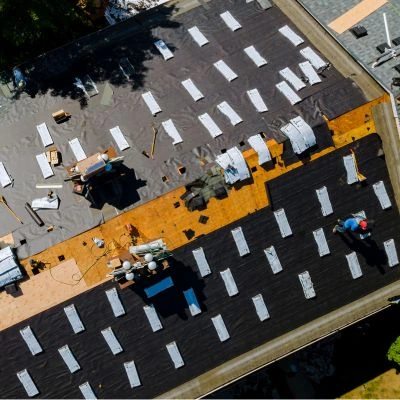
As part of the Tax Cuts and Jobs Act (TCJA), Section 179 allows businesses to deduct the cost of qualifying improvements—such as a commercial roof replacement—in the year the expenditure is placed into service.
New for 2025: The One Big Beautiful Bill Act (OBBBA) significantly expands this deduction. For assets placed in service after December 31, 2024, businesses can elect to immediately deduct up to $2.5 million, with a phase-out beginning at $4 million of total qualified purchases.
Regarding bonus depreciation, 2025 marks a sharp shift. Any qualified property placed in service beginning January 20, 2025, is eligible for 100% bonus depreciation, fully expensed in the year it is placed in service—no phase-out applies. Note that property placed in service between January 1 and January 19, 2025, remains eligible only for 40% bonus depreciation, per transitional rules.
Example: If your business replaces its commercial roof for $100,000 and it’s placed into service on February 1, 2025, you may:
- Use Section 179, deducting the full $100,000 (assuming the overall limit isn’t exceeded); or
- Apply 100% bonus depreciation, fully expensing the cost in 2025.
As always, you should consult your tax advisor to evaluate how this information affects your long-term financial goals.
Hiring A Knowledgeable Contractor For A Residential Or Commercial Roof Replacement
Central and Southwest Florida homeowners and commercial property managers know they can trust Alan’s Roofing for all their residential and commercial roofing needs. As the most experienced roofing company in Central Florida, we offer peace of mind that the roofing work will meet or exceed your expectations – every time.
At Alan’s Roofing, we don’t compromise on craftsmanship or roofing products. We set a standard of excellence that permeates every aspect of our business approach to your roofing project. If you need a residential or commercial roof replacement, contact Alan’s Roofing to arrange a consultation and receive a free, no-obligation quote.