Choosing commercial roofing materials for your Central Florida property involves more than picking what looks good or costs the least upfront. Your roof faces relentless UV exposure, summer heat that bakes surfaces to 160°F, driving rain that tests every seam, and hurricane-force winds that threaten to peel back inadequate installations. Alan’s Roofing has installed commercial roofs across Central Florida since 1987, and we’ve seen firsthand which materials stand up to these brutal conditions and which fail within years.
This guide examines the commercial roofing materials best suited for Central Florida’s climate, comparing their durability, hurricane resistance, energy efficiency, lifespan, and costs. Whether you manage a warehouse with a flat roof or a retail center with sloped sections, you’ll find the information you need to make a confident material selection.
Understanding Central Florida’s Roofing Challenges
Central Florida’s subtropical climate creates a hostile environment for commercial roofs. Daily temperature swings cause materials to expand and contract repeatedly, creating stress on seams and fasteners. Summer temperatures regularly exceed 95°F, with roof surface temperatures climbing 60-70 degrees higher. This constant heat degrades organic materials, softens adhesives, and accelerates aging. UV radiation at Florida’s latitude is among the most intense in the continental United States, breaking down chemical bonds in roofing materials and causing brittleness, cracking, and color fading over time.
Hurricane season brings sustained winds exceeding 100 mph in major storms, with gusts reaching much higher speeds. The Florida Building Code requires commercial roofs to meet specific wind uplift ratings based on building height, roof geometry, and location. Materials that perform adequately in northern climates often fail catastrophically when subjected to hurricane conditions. Ponding water from afternoon thunderstorms tests drainage systems and material integrity. Properties near the coast face additional salt spray exposure that corrodes metal components and degrades certain membrane materials faster than inland installations.
TPO: The Most Popular Commercial Flat Roof Material
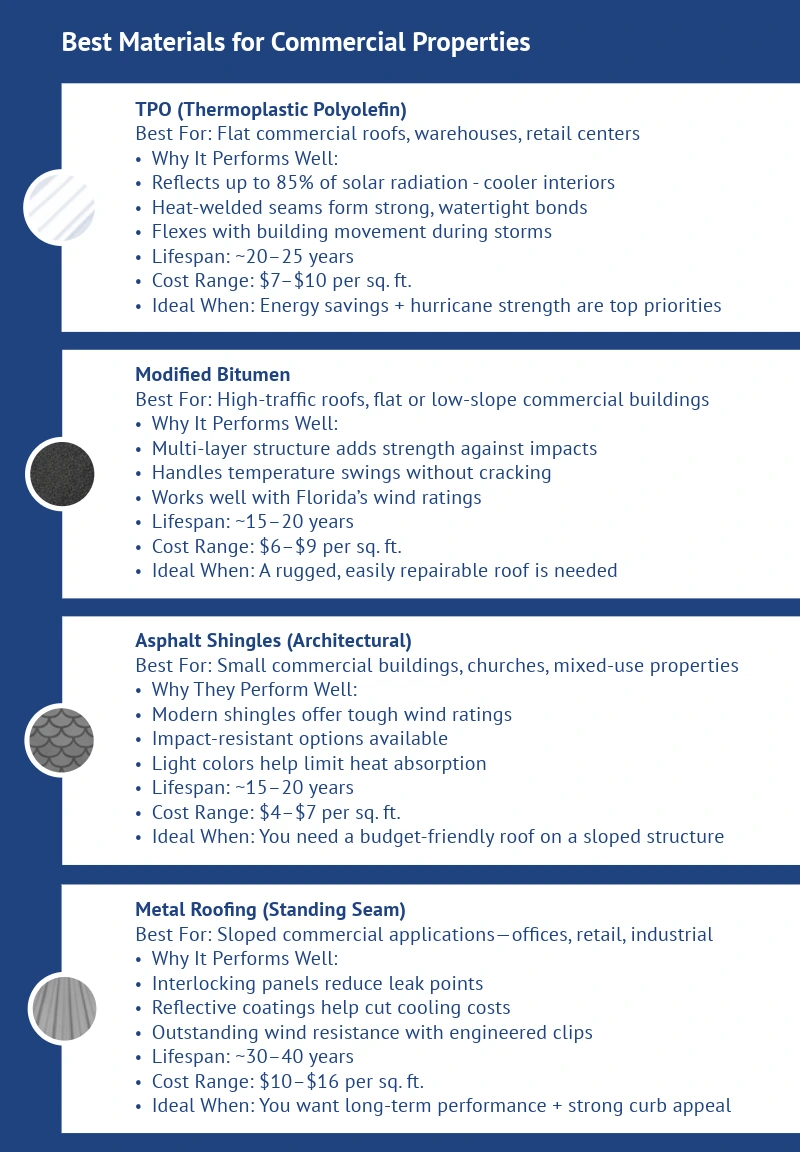
Thermoplastic Polyolefin (TPO) dominates commercial flat roofing in Central Florida because it addresses multiple climate challenges simultaneously. TPO membranes feature a bright white reflective surface that bounces back up to 85% of solar radiation, keeping roof surface temperatures 30-50 degrees cooler than dark materials. This reflectivity translates directly to lower air conditioning costs. The material’s heat-welded seams create watertight bonds stronger than the membrane itself, eliminating the leak-prone adhesive seams found in older systems.
TPO performs exceptionally well in hurricane conditions when properly installed. The mechanically-attached systems we install use specialized fasteners and plates engineered to meet Florida Building Code wind uplift requirements. Heat-welded laps create continuous waterproofing that won’t separate under wind pressure. TPO’s flexibility allows it to accommodate building movement during high winds without tearing or separating from substrates. The material performs well against wind-borne debris when fully adhered or mechanically attached, though any commercial roof should be inspected after major storms.
Quality TPO installations typically last 20-25 years in Central Florida before requiring replacement. The material resists mold and algae growth, maintains its reflective properties throughout most of its lifespan, and requires minimal maintenance beyond regular inspections and debris removal. Installation costs generally run $7 to $10 per square foot, depending on roof complexity, insulation requirements, and existing conditions. A typical 10,000 square foot commercial roof replacement takes 3-5 days under favorable weather conditions, with minimal business disruption when properly scheduled.
Modified Bitumen: Proven Durability for Florida Roofs
Modified bitumen roofing systems have protected commercial buildings in Florida for over 40 years, earning a reputation for reliable performance and straightforward repairs. These systems consist of asphalt modified with rubber or plastic polymers, reinforced with polyester or fiberglass mats, and surfaced with mineral granules or reflective coatings. The multi-layer construction creates a tough, puncture-resistant surface that withstands foot traffic, falling branches, and debris impacts better than single-ply membranes.
Its flexible nature lets it move with temperature shifts without breaking or developing splits. Quality modified bitumen systems maintain their integrity through years of Central Florida’s temperature extremes. When surfaced with reflective granules or coatings, modified bitumen provides good solar reflectance, though not quite matching TPO’s performance. Property owners typically see moderate energy savings compared to dark-colored roofing, with the exact amount depending on coating selection and maintenance.
Modified bitumen performs well in hurricane conditions when installed with proper wind uplift ratings. The torched or cold-applied installation methods create secure attachment to roof decks, and the material’s weight and flexibility help it resist wind forces. Seams are fully adhered or heat-welded, creating continuous waterproofing. Expected lifespan runs 15-20 years in Central Florida’s climate, with granule-surfaced versions lasting toward the upper end of that range. Installation costs typically range $6-9 per square foot. The familiar technology means most commercial roofing contractors can competently install and repair modified bitumen, simplifying future maintenance.
Metal Roofing: Long-Term Performance for Sloped Commercial Applications
Metal roofing excels on sloped commercial applications like retail centers, office buildings, and industrial facilities with pitched roof sections. Standing seam metal roofs feature interlocking panels with concealed fasteners, eliminating penetrations that could leak. The material’s strength-to-weight ratio is exceptional, allowing it to span longer distances with less structural support than heavier materials. Metal roofs shed water immediately rather than relying on membrane waterproofing, reducing leak potential in intense rain events common to Central Florida.
Reflective metal roofing coatings bounce back 60-70% of solar radiation, significantly reducing heat transfer into buildings. This “cool roof” performance lowers air conditioning loads and creates more comfortable interior conditions. Many property owners report substantial energy savings, particularly in buildings with less insulation or older HVAC systems. The material requires virtually no maintenance beyond periodic inspections and debris removal from valleys and gutters.
Hurricane resistance is outstanding when metal roofing is properly engineered and installed. Standing seam systems with structural attachment clips meet the most stringent wind uplift requirements. The material’s flexibility allows panels to deflect under wind loads without permanent damage. Metal roofing commonly lasts 30-40 years in Central Florida before requiring replacement, making it the longest-lived option. Installation costs run $10 to $16 per square foot, depending on panel profile, gauge, and coating selection. Installation timelines vary based on roof condition, complexity, permitting, and weather, but typically require 1-2 weeks for average commercial projects.
Asphalt Shingles: Cost-Effective Solutions for Smaller Commercial Buildings
Asphalt shingles serve many smaller commercial buildings, churches, and mixed-use properties with sloped roofs. Modern architectural shingles bear little resemblance to the thin three-tab shingles of previous decades. Today’s products feature thick, multi-layered construction with enhanced wind resistance ratings, improved granule adhesion, and better UV resistance. Impact-resistant shingles with Class 4 ratings resist hail damage and falling debris. Choosing these may potentially qualify for insurance discounts. Properly installed architectural shingles rated for high-wind zones perform acceptably in hurricane conditions when building geometry doesn’t create excessive uplift forces.
Shingle color selection impacts energy performance significantly. Light-colored shingles with reflective granules reduce heat absorption compared to dark colors, and proper attic ventilation allows heat escape. Energy savings are modest compared to commercial membrane systems but better than uncoated dark surfaces.
Expected lifespan for quality architectural shingles in Central Florida runs 15-20 years, with dimensional shingles toward the upper end of that range. The intense UV exposure and afternoon heat cycles limit longevity compared to northern climates, where the same products might last 25-30 years. Installation costs typically range $4 to $7 per square foot, making shingles the most economical option for sloped commercial applications. A typical commercial shingle roof replacement takes 2-4 days, depending on size and complexity.
Factors That Extend Commercial Roof Lifespan
Material selection matters, but installation quality and ongoing maintenance determine whether your commercial roof reaches its expected lifespan. Proper substrate preparation creates the foundation for long-term performance. Damaged or wet roof decking must be replaced before new roofing installation. Adequate insulation and proper drainage design prevent the moisture accumulation and ponding water that accelerate material degradation. Edge details, penetration flashings, and termination bars require meticulous installation to prevent the wind-driven rain infiltration that causes most commercial roof leaks.
Regular professional roof inspections catch minor issues before they become major problems. We recommend twice-yearly inspections for commercial roofs in Central Florida, ideally in spring before hurricane season and fall after storm season ends. These inspections identify loose fasteners, damaged flashings, clogged drains, and early membrane damage. Keeping your roof clean of debris, tree branches, and organic growth also extends material lifespan by preventing moisture retention and membrane damage.
After major storms, a prompt professional inspection identifies damage requiring immediate attention. Small punctures and lifted seams are easily repaired if caught quickly, but waiting allows water infiltration that damages substrates and building interiors. Insurance claims are strengthened by documentation of proper maintenance and prompt damage reporting. Properties with documented maintenance histories and professional installation typically experience fewer insurance disputes and faster claim resolution.
Making Your Commercial Roofing Material Decision
Your commercial roofing material choice should balance upfront costs, expected lifespan, energy performance, and maintenance requirements. A 20,000 square foot warehouse roof represents a significant investment, whether you choose TPO at $8 per square foot ($160,000) or modified bitumen at $7 per square foot ($140,000). However, the $20,000 difference becomes minor when compared to energy savings over 20 years and the costs of premature replacement if the lower-cost option fails early.
Building use also affects material selection. Food service facilities benefit from TPO’s resistance to grease and cooking oils. Warehouses with heavy rooftop equipment need modified bitumen’s puncture resistance. Retail properties value metal roofing’s curb appeal and longevity. Climate exposure matters too—coastal properties face harsher conditions than inland locations, potentially justifying premium materials even for basic warehouse applications. Your building’s structural capacity may limit options since some materials require more support than existing structures provide without costly reinforcement.
Don’t rely solely on the lowest bid. The cheapest quote often comes from contractors cutting corners on materials, labor, or building code compliance. These installations fail early and cost more in the long run. Experienced commercial roofing contractors provide detailed specifications, explain material options honestly, and help you understand how each choice affects your property’s performance and value. They identify potential issues before installation begins and engineer solutions that extend roof life rather than creating future problems.
Get Expert Guidance on Commercial Roofing Materials
Selecting the best commercial roofing materials for your Central Florida property requires understanding how different options perform in our specific climate. TPO delivers excellent hurricane resistance and energy savings for flat roofs. Modified bitumen offers proven durability and straightforward repairs. Metal roofing provides unmatched longevity for sloped applications. Asphalt shingles serve smaller buildings cost-effectively. Each material has ideal applications and limitations that affect long-term performance and cost.
Contact Alan’s Roofing today for a free commercial roofing assessment. Our team evaluates your specific building, explains material options suited to your needs and budget, and provides detailed proposals with clear specifications. We’ve installed thousands of commercial roofs across Central Florida since 1987, and our experience helps you avoid costly mistakes while maximizing your roofing investment.